Public intents
From a OP Stack chain to Aztec
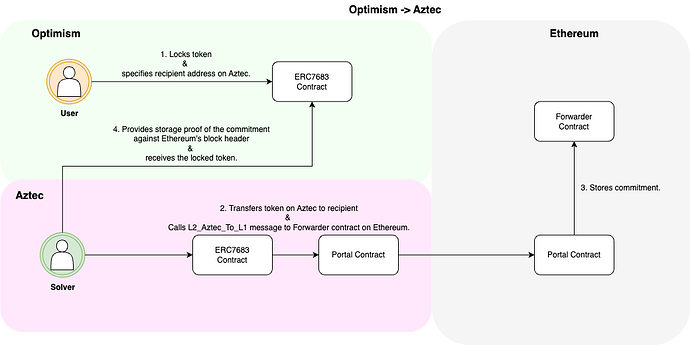
A user creates an intent in the ERC-7683 contract on the OP stack chain.
A filler detects the user’s intent and transfers the specified funds to the user on Aztec via the ERC-7683 contract deployed there.
In the same transaction, the filler sends an L2_aztec-to-L1 message to the Forwarder contract on Ethereum, signaling that the transfer has been completed on Aztec.
The Forwarder contract on Ethereum receives the L2_aztec-to-L1 message and stores a commitment of the intent on-chain.
This commitment proves that the filler has successfully transferred the user’s funds on Aztec.
Because on a OP stack chain it’s possible to read Ethereum block headers, the filler can verify this recorded commitment on the OP stack chain using a storage proof against an Ethereum block header.
After verification, the filler claims reimbursement for completing the user’s transfer.
From Aztec to a OP stack chain
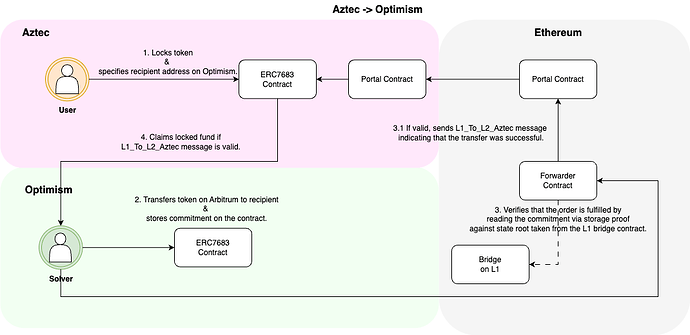
A user creates an intent in the ERC-7683 contract on Aztec, specifying a destination address on the OP Stack chain.
A filler detects this intent, transfers the specified funds to the user on the OP stack chain and records a commitment in the ERC-7683 contract confirming that the transfer took place.
Once the OP stack chain state root is finalized on Ethereum (L1), the Forwarder contract verifies—via storage proofs against that OP stack chian state root—that the filler has indeed fulfilled the intent. Specifically, it reads the commitment from the ERC7683 contract storage on the OP stack chain and validates it against the OP stack chain state root taken from the L2 bridge contract on L1 using storage proofs.
After verification, the Forwarder sends an L1-to-L2_aztec message to Aztec, indicating that the transfer was successful.
When Aztec receives the L1-to-L2_aztec message, the filler can claim their reimbursement, completing the settlement process.
If Aztec would gain direct access to Ethereum blocks, then this verification could be performed on Aztec rather than on L1, thereby reducing both gas costs and overall complexity.
Last updated